Business

Research and Development

Continuously Researching and Advancing TLT

Ministry of Environment logo KEITI logo

Water & Sewerage Innovative Technology Development Program

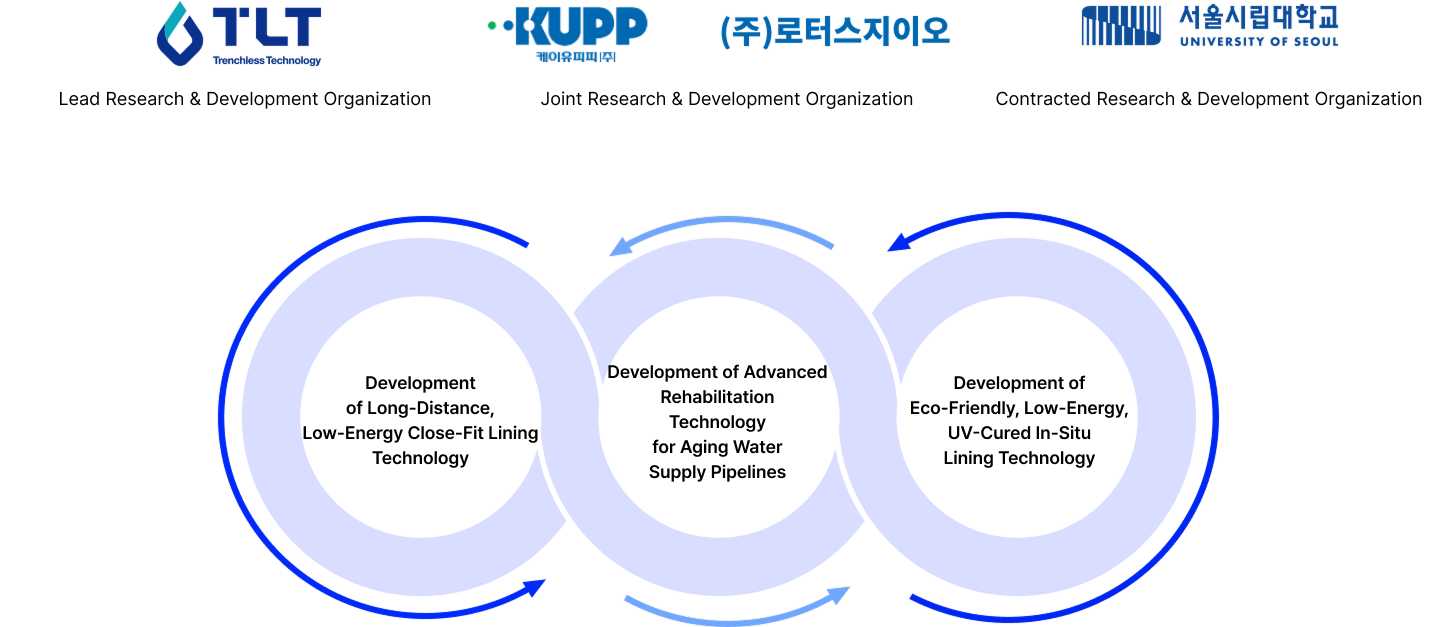
  • ∙ Project Title : Development of Long-Distance, Low-Energy Rehabilitation Technology for Water Pipelines Using High Elasticity and UV
  • ∙ Research Objective : To secure advanced water pipeline rehabilitation technology by developing trenchless rehabilitation methods that do not require ground excavation, low-energy high-efficiency rehabilitation methods, and environmentally friendly rehabilitation methods for improving aged water pipelines
  • ∙ Research Period : 2020.05 ~ 2022.09
Water & sewerage innovative technology development program image Water & sewerage innovative technology development program mobile image

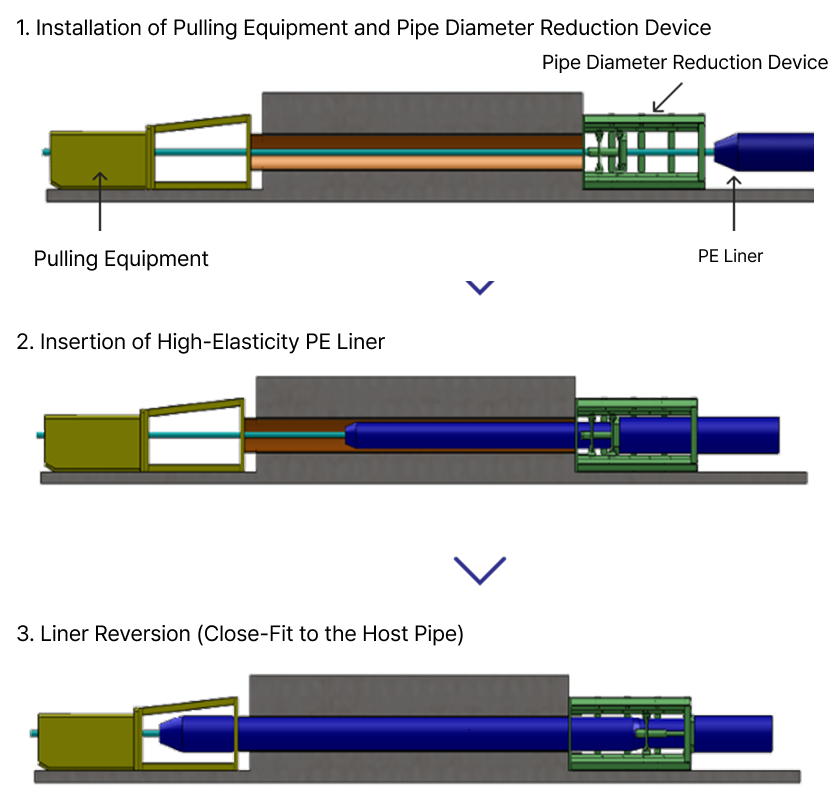
[Development of Long-Distance · Low-Energy Close-Fit Lining Technology]

  • Close-Fit Lining rehabilitation technology that enables low-energy, long-distance installation while ensuring structural reinforcement by using a high-elasticity PE liner

Specifications for Long-Distance, Low-Energy Close-Fit Lining Technology

Category Specification Remarks
Applicable Pipe Types DCIP, CIP, SP, Concreate, etc.
Applicable Diameter 300mm ~ 1,000mm
Single Installation Length At least 200m or more Adjusted upward from target
Energy Reduction 100% energy reduction (liner elastic recovery force)
Structural Reinforcement Class Meets AWWA Class Ⅱ ~ Ⅳ* depending on environmental conditions Selected based on diagnostic results

*AWWA Class Ⅱ : Internal pressure reinforcement, Class Ⅲ : External pressure reinforcement, Class Ⅳ : Internal + external pressure reinforcement
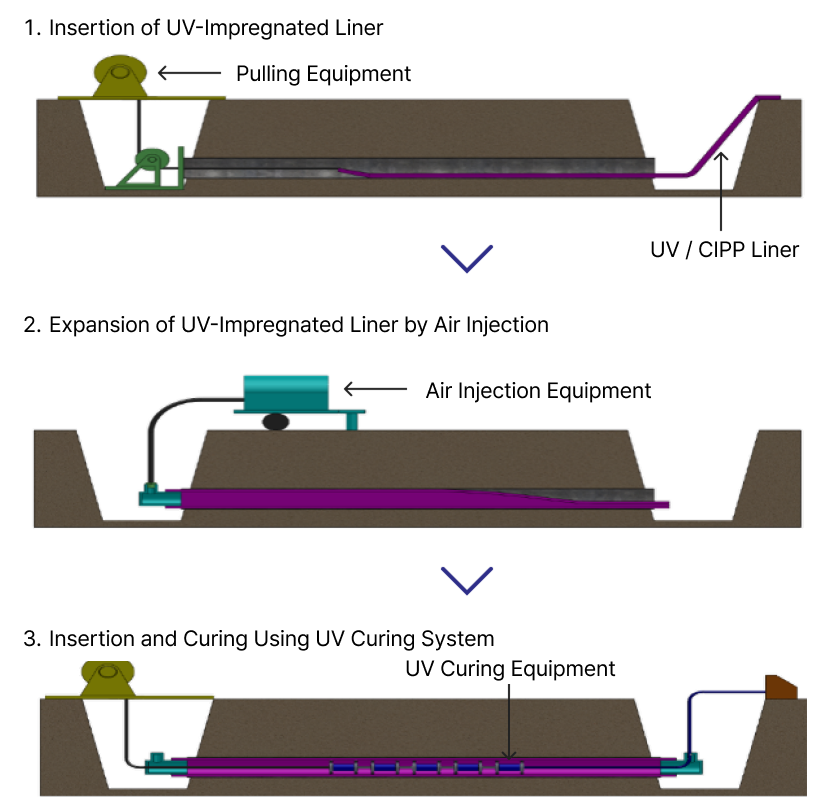
[Development of Eco-Friendly, Low-Energy UV Cured-In-Place (CIPP) Lining Technology]

  • Cured-in-place CIPP rehabilitation technology that cures a high-strength liner using UV for low-energy, high-efficiency performance

Specifications for Eco-Friendly, Low-Energy UV Cured-In-Place Lining Technology

Category Specification Remarks
Applicable Pipe Types DCIP, CIP, SP, Concreate, etc.
Applicable Diameter 300mm ~ 1,500mm
Single Installation Length At least 200m or more Adjusted upward from target
Energy Reduction 50% energy reduction (UV curing)
Structural Reinforcement Class Meets AWWA Class Ⅱ ~ Ⅳ* depending on environmental conditions Selected based on diagnostic results

*AWWA Class : Internal pressure reinforcement, Class : External pressure reinforcement, Class : Internal + external pressure reinforcement
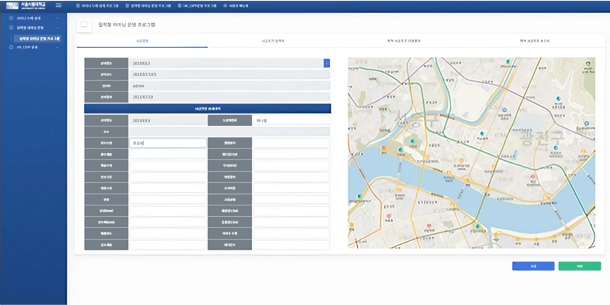
Optimal Installation & Operation Program for High-Elasticity PE Liner (PE-CFL)

  • Input of pre-construction review items (average ambient temperature (℃), PE liner diameter (mm), SDR, target diameter recovery rate (%), PE liner length (m), etc.)
  • ▶ Calculates the minimum pulling force required for construction and determines liner elongation due to PE liner pulling to select the pulling equipment needed for on-site installation
  • Output values from pre-construction review items (pulling force, estimated pulling time, minimum reduced diameter at pulling start, etc.)
  • ▶ Determines optimal construction conditions (design of the rear inspection pit size, final PE liner length, PE liner recovery time, and required water volume for hydrostatic testing, etc.)

On-Site Execution

Control No. / Control Code / Control Date / Administrator Raw Water System / Pipeline Classification / Diameter / Pipe Type and Wall Thickness Burial Year / Burial Depth / Frost Depth, etc.

Pre-Construction Review Items

Input

Construction date, average ambient temperature, installed diameter (mm) / installed length (m) / PE liner diameter (mm) SDR, PE liner thickness (mm), diameter reduction rate (%) Target diameter recovery rate (%), inspection pit size

Output

Pulling force (bar), estimated pulling time (min), minimum reduced diameter at pulling start (mm) Increased PE liner length upon completion of pulling (m) Required number of pulling rods, suitability of inspection pit size

Determination of Optimal Construction Conditions

Input

Construction date, average ambient temperature, PE liner diameter (mm), SDR, PE liner thickness (mm), installed length (m) Inspection pit size, diameter reduction rate (%), target diameter recovery rate (%), target natural recovery rate (%) Recovery rate for hydrostatic testing (%), recovery start time

Output

Delayed recovery time required (min), hydrostatic testing time required (min), diameter at start of hydrostatic testing (min) Required water pressure (bar), required water volume for pressure (m3) Final recovery rate (%), total construction time (min), diameter recovery completion time

Optimal Installation & Operation Program for UV-CIPP Liner

  • Input conditions for pre-construction review items (UV-CIPP liner diameter (mm) and average ambient temperature (℃), etc.)
  • ▶ Outputs required liner wall thickness (mm), number of curing units needed, average internal curing temperature (℃), average curing unit travel speed (m/min), and average internal liner pressure (kg/㎠), and uses them as review items for necessary equipment before construction
  • Based on construction condition outputs, calculates UV-CIPP liner curing time (min) and UV-CIPP liner air injection time, cooling time, and construction end time
  • ▶ Ultimately determines the construction end time (※Cooling time: time required for the photopolymerization reaction of the curing felt to finish after lamp irradiation ends)

On-Site Execution

Control No. / Control Code / Control Date / Administrator Raw Water System / Pipeline Classification / Diameter / Pipe Type and Wall Thickness Burial Year / Burial Depth / Frost Depth, etc.

Pre-Construction Review Items

Input

Construction date, average ambient temperature, installed diameter (mm) / installed length (m) UV-CIPP liner diameter (mm), UV-CIPP liner thickness (mm) Inspection pit size, curing unit type based on liner diameter

Output

Compliance with UV-CIPP liner thickness (mm) 기준만족 여부, curing unit lamp specification (W), number of curing unit lamps (units) Compliance with curing unit specification and quantity 기준만족 여부, total required power (W) Average curing unit travel speed (m/min), suitability of inspection pit size

Determination of Optimal Construction Conditions

Input

Construction date, average ambient temperature, installed diameter (mm) / installed length (m), UV-CIPP liner thickness (mm) Curing unit lamp specification (W), number of curing unit lamps (units), average curing unit travel speed (m/min) Maximum internal liner curing temperature, average internal liner pressure, construction start time

Output

Suitability of maximum internal liner curing temperature, suitability of average internal liner pressure UV-CIPP curing time required, UV-CIPP liner air injection time (min) UV-CIPP liner cooling time (min), construction end time